


Quiet Flight
At Pivotal, we design light eVTOL aircraft for the real world — where people live, work, and play. That means we deliver more than safe performance in the air. It also means a quiet presence from the ground.
Electric aircraft are the future of flight, whether the aircraft are aimed at consumer, commercial public safety, or defense markets. Yet to become part of everyday life, eVTOL makers must earn public trust. And one major challenge to trust is noise.
This is understandable, given that fuel-powered planes and helicopters generate intense sound that can carry long distances and disrupt communities. As a result of the noise level they generate, traditional aircrafts must operate under limits as to where and when they can fly. By contrast, Pivotal eVTOLs are engineered to be something different entirely: quiet by design.
Before getting into the details of the acoustics, it may be useful to explain the two modes of eVTOL flight. When an eVTOL is taking off and landing vertically, it is in hover mode. The propellers are aimed skyward, and the motors drive props to generate the thrust needed to lift the aircraft for takeoff and landing. This is the principle underlying Pivotal’s eVTOL flight.
But unlike helicopters, Pivotal’s fixed winged eVTOLs transition from hover to cruise after takeoff by tilting forward, using the lift provided by the wings.
Cruise mode requires much less power than hover, and as you’d expect, the sound level is significantly lower as well. A positive note is that hover mode lasts only around 30 seconds for the average takeoff and the same for landing. So, for a flight lasting 15 minutes, cruise mode accounts for over 90% of the total flight time, with hover less than 10%. The second benefit of cruise mode is that the aircraft is flying at a higher elevation, typically 150 feet or greater, and therefore less audible.

Quiet Flight
At Pivotal, we design light eVTOL aircraft for the real world — where people live, work, and play. That means we deliver more than safe performance in the air. It also means a quiet presence from the ground.
Electric aircraft are the future of flight, whether the aircraft are aimed at consumer, commercial public safety, or defense markets. Yet to become part of everyday life, eVTOL makers must earn public trust. And one major challenge to trust is noise.
This is understandable, given that fuel-powered planes and helicopters generate intense sound that can carry long distances and disrupt communities. As a result of the noise level they generate, traditional aircrafts must operate under limits as to where and when they can fly. By contrast, Pivotal eVTOLs are engineered to be something different entirely: quiet by design.
Before getting into the details of the acoustics, it may be useful to explain the two modes of eVTOL flight. When an eVTOL is taking off and landing vertically, it is in hover mode. The propellers are aimed skyward, and the motors drive props to generate the thrust needed to lift the aircraft for takeoff and landing. This is the principle underlying Pivotal’s eVTOL flight.
But unlike helicopters, Pivotal’s fixed winged eVTOLs transition from hover to cruise after takeoff by tilting forward, using the lift provided by the wings.
Cruise mode requires much less power than hover, and as you’d expect, the sound level is significantly lower as well. A positive note is that hover mode lasts only around 30 seconds for the average takeoff and the same for landing. So, for a flight lasting 15 minutes, cruise mode accounts for over 90% of the total flight time, with hover less than 10%. The second benefit of cruise mode is that the aircraft is flying at a higher elevation, typically 150 feet or greater, and therefore less audible.
Acoustic Study
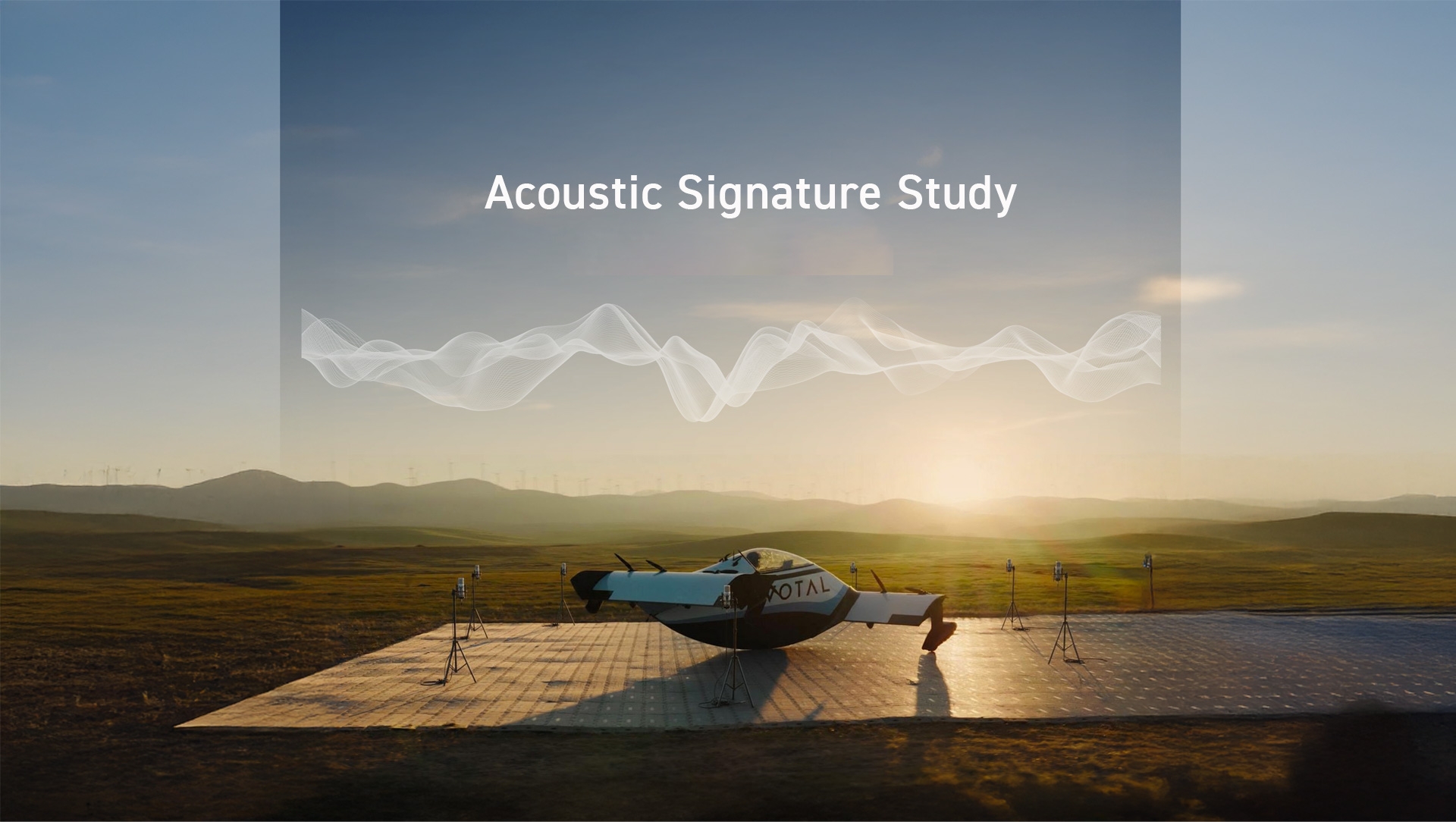
To quantify the sound print during cruise and hover mode, we sought empirical evidence from the Mobile Acoustics Facility at NASA, a respected independent research organization experienced in conducting acoustic studies with eVTOL manufacturers.

NASA used advanced tools, including a 24-microphone array, to systematically capture noise data from different angles and distances to measure factors that influence noise, such as speed, altitude, and flight path.
Research at Springfield-Beckley Municipal Airport, NASA captured and analyzed the acoustic signature of the BlackFly aircraft being flown today by customers in our Early Access Program.
To ensure the collection of reliable, valid data, the NASA team measured noise in both hover and cruise configurations, using techniques such as Real-Time Kinematic (RTK) surveying for microphone placement, Fast Fourier Transforms (FFT) for signal processing, atmospheric adjustments, dynamic averaging across flyover data, and measuring signal-to-noise ratios to categorize sound levels.
How We Achieve Quiet Aircraft
How did we achieve the low sound signature? It starts with the design. Pivotal’s patented tilt-aircraft architecture completely avoids a huge amount of complexity. There are no rotating wings. No tilting rotors. And no noisy gas engines. Eight proprietary electric motors deliver bursts of thrust for precise control of the aircraft and quiet, efficient propulsion in cruise, always emission free. Pivotal’s clean, tilt-aircraft architecture isn’t just quieter—it’s simpler, safer, and more reliable.
Low noise unlocks access. It allows light eVTOLs to operate where conventional aircraft can’t go.
- For recreation and short hop travel, it means the freedom to fly without the backlash.
- For first responders, it means getting to a scene faster—without disrupting the community.
- For defense, it means covert mobility and rapid deployment.


Defining Quiet Flight
NASA’s independent acoustic testing confirms what our engineers and flight teams have long known: Pivotal aircraft are among the quietest vehicles of their kind.
The research shows the Pivotal BlackFly produces 70 dBA flyover noise at 100 feet. dBA is a variation of dB (decibel) that measures sound using a weighted scale that corresponds to the hearing threshold of the human ear.

The next chapter of aviation will be quieter, cleaner, and more accessible.
As electric flight technologies mature, the focus is shifting from what’s possible in the air to include what’s practical on the ground. Communities, regulators, and early adopters are aligned on a key point: future eVTOL aircraft must respect the environments they fly over. That means dramatically reducing noise.
This is where Pivotal’s light eVTOLs are uniquely suited to thrive. Compact, efficient, and nearly silent in flight, they’re enabling a future where flying vehicles fit into daily life—not apart from it.
Author: Soummya Datta
Soummya (“show-moe”) Datta is the VP and Chief of Engineering at Pivotal. He has a B.S. and M.S. degree in mechanical engineering from University of California, Berkeley. He also holds an M.B.A. from the Anderson School of Management at UCLA where he graduated with honors.
